Brown, gray, red-brown, or lighter patches can look similar in a mirror while requiring completely different care. By the end, you will know which visual clues matter, what a dermatologist needs to ask, when a mark needs medical assessment, and how to judge whether a treatment fits the cause rather than its marketing claim.
Key takeaways
- Treat uneven tone as a symptom, not a diagnosis.
- Ask what caused the pigmentation before choosing a lightening treatment.
- Control sun exposure, irritation, and medicines that worsen pigment.
- Match treatment to the diagnosis, skin type, and risk of side effects.
Uneven skin tone is a symptom, not a diagnosis
Brown patches are not a diagnosis. Uneven skin tone can reflect excess pigment, loss of pigment, inflammation, medication effects, or a separate skin disorder, so the pattern matters before you choose a lightening treatment.
| Condition | Visual pattern | Clues that support it |
|---|---|---|
| Melasma | Symmetrical tan-to-brown patches on the cheeks, forehead, nose, or upper lip | Gradual onset; pregnancy, hormonal contraception, heat, and sunlight can worsen it |
| Post-inflammatory hyperpigmentation | Flat brown marks exactly where acne, eczema, a burn, picking, or a procedure occurred | The original inflammation or injury came first |
| Sun-induced lentigines | Sharply defined, persistent brown spots on sun-exposed hands, face, chest, or shoulders | Individual spots remain fairly stable and do not fade like freckles |
| Freckles | Numerous small, light-brown macules, often on the nose and cheeks | They darken in summer and lighten with reduced sun exposure |
| Friction or medication-related pigmentation | Darkening in rubbing areas, skin folds, or broad exposed zones | Tight clothing, repeated irritation, or a new medicine may precede it |
| Vitiligo or pityriasis versicolor | Pale or white patches rather than brown ones | Vitiligo can have sharply contrasting borders; pityriasis versicolor may show fine scale |
Melasma can worsen from visible light, not just ultraviolet radiation. A sunscreen containing iron oxides can therefore matter for facial melasma, while pigment suppression alone will not stop PIH if acne or eczema remains active.
Arrange medical assessment for a rapidly changing spot, bleeding, ulceration, persistent itching, one lesion unlike the others, or pigment on the lips or other mucosal surfaces.
What a dermatologist checks before naming the cause
A pigmentation consultation determines the cause through history, examination, and targeted testing rather than colour alone. The dermatologist maps where the change began, whether it is symmetrical, how quickly it appeared, and whether a rash, acne, eczema, burn, picking, procedure, pregnancy, hormonal treatment, or new medicine came first.
1. The clinician examines texture and pattern. Flat, symmetrical patches suggest melasma; marks at previous inflammation suggest post-inflammatory hyperpigmentation; sharply defined isolated spots suggest sun-induced lentigines. Scaling, redness, itch, or ongoing irritation points to an active skin disorder.
2. The clinician estimates depth. Epidermal and dermal pigmentation can look similar under ordinary light. A Wood’s lamp may make epidermal pigment more prominent, but it cannot reliably separate epidermal from dermal melasma in every skin type, so it remains an adjunct rather than a definitive depth test.
3. The medication and hormonal history can reveal a trigger. Ask about minocycline, amiodarone, antimalarials, oral contraceptives, pregnancy, and endocrine symptoms. Do not stop a prescribed drug without the prescriber’s advice; blue-gray or slate-gray pigment can persist after withdrawal.
4. A changing or solitary lesion receives a safety check before cosmetic treatment. Asymmetry, multiple colours, bleeding, ulceration, persistent itching, rapid growth, or mucosal involvement warrants dermoscopy and biopsy when indicated. Empiric bleaching can irritate skin, worsen post-inflammatory pigmentation, and alter a lesion’s appearance before diagnosis.
Find and control the trigger before lightening the skin
Control the active trigger—inflammation, product reaction, rubbing, or light exposure—before trying to fade the leftover colour. Pigment suppressors alone cannot stop new post-inflammatory hyperpigmentation, and irritated skin can darken further after aggressive treatment.
| Trigger or condition | Clues | What to control first |
|---|---|---|
| Acne and eczema | Marks follow spots, scratching, or an itchy rash | Treat active inflammation, avoid picking, and repair the skin barrier |
| Contact dermatitis from skin-care products | Burning, itching, scaling, or a rash after cosmetics, fragrances, hair products, or new treatments | Stop suspected products and simplify the routine; investigate allergy if symptoms persist |
| Friction-related darkening | Darkening where masks, collars, straps, shaving, or repeated rubbing contact the skin | Remove the friction and change the irritating habit or equipment |
| Ultraviolet and visible light | Melasma worsens on exposed facial areas, especially the cheeks, forehead, nose, or upper lip | Use broad-spectrum sunscreen, preferably with iron oxides, plus shade and a hat |
| Hormonal or medication triggers | Pigment begins after pregnancy, hormonal contraception, hormone therapy, or a new medicine | Review timing and medication risks with a clinician before changing treatment |
Treating acne or eczema reduces the injury that keeps producing pigment. Do not add stronger acids, retinoids, or bleaching products to skin that is burning or peeling.
Melasma can relapse when light exposure or hormonal influence continues, so maintenance protection matters after improvement. Rapidly changing, bleeding, ulcerated, persistently itchy, or unusually solitary pigmentation needs medical assessment before cosmetic treatment.
Choose treatment by diagnosis, skin type, and risk
Sun protection is the baseline, not a complete diagnosis. Choose the next step according to the cause, the depth of pigment, your Fitzpatrick skin type, and the risk of post-inflammatory hyperpigmentation.
| Option | What it means | When it applies |
|---|---|---|
| Sun protection | Broad-spectrum SPF 30 or higher, protective clothing, and reapplication outdoors | Every cause, especially melasma, lentigines, and treatment-related darkening |
| Prescription topicals | Prescription hydroquinone, retinoids, azelaic acid, or other clinician-selected agents | Melasma or post-inflammatory hyperpigmentation after the trigger is controlled; stop or adjust if irritation worsens pigment |
| Active-condition treatment | Treat acne, eczema, dermatitis, infection, friction, or a medication trigger | Pigment that will recur while inflammation, rubbing, or exposure continues |
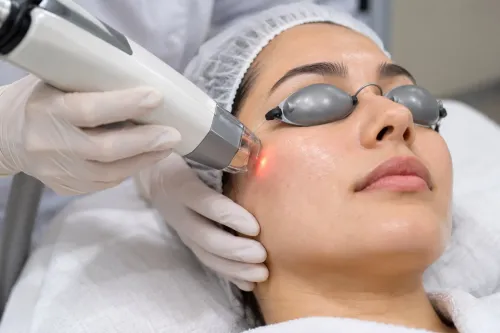
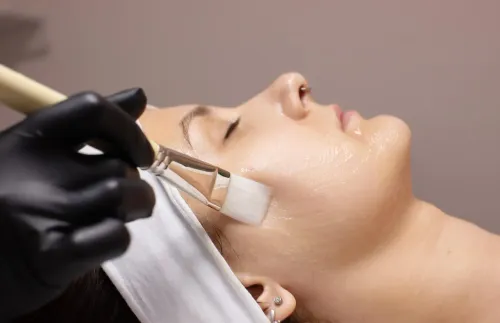
| Chemical peels and laser procedures | Controlled injury intended to reduce selected superficial or deeper pigment | Resistant, clearly diagnosed pigment after conservative treatment; use test areas and settings suited to your Fitzpatrick skin type |
| Observation | Monitor without pigment treatment | Stable freckles, benign lesions, or pigment that is fading after inflammation stops; reassess changing lesions |
Topical corticosteroid combination creams can reduce melasma briefly, but they are not indefinite fairness creams. Prolonged or unsupervised use can cause acneiform eruptions, skin thinning, visible vessels, rosacea-like dermatitis, and steroid-related worsening.
Ask about duration and review dates for prescription hydroquinone; inappropriate prolonged use can cause blue-black or gray-brown exogenous ochronosis. Avoid procedures during active melasma or dermatitis unless the diagnosis and risk plan are clear, because inflammation can produce rebound darkening.
Rapidly changing, bleeding, ulcerated, persistently itchy, or solitary unusual lesions need medical assessment rather than cosmetic lightening.
Questions that reveal whether a treatment plan is appropriate
Before consenting, ask for a diagnosis-linked forecast, not a promise of “glowing” skin. Pigment can fade without disappearing, and melasma or post-inflammatory hyperpigmentation can return if hormones, light exposure, acne, eczema, or friction continue.
1. What result is realistic for my cause, skin tone, and pigment depth, and how will we measure it? Ask whether improvement means lighter patches, fewer new marks, or complete clearance; these are not the same pigmentation treatment expectations.
2. What is my recurrence risk, and which trigger must I control? For melasma, ask specifically about ultraviolet and visible-light protection, hormonal contraception, hormone therapy, pregnancy and breastfeeding before starting prescription products or procedures.
3. How many sessions are likely, what interval separates them, and what happens if improvement stops? A plan that cannot explain its stopping point needs clarification.
4. What downtime should I expect? Ask about redness, peeling, swelling, work restrictions, and post-inflammatory hyperpigmentation, especially after a peel or laser on darker skin.
5. What is the treatment maintenance schedule? Confirm sunscreen use, reapplication, follow-up visits, and whether intermittent clinician-directed topical therapy is needed.
6. If the area darkens, who reviews it and what changes immediately? Procedure-induced inflammation can worsen active melasma, so do not accept “push through” as an explanation.
Dr. Swati Gurav Dermatologist & Cosmetologist can help compare observation, topicals, peels, and laser by diagnosis and risk, including whether a test area is sensible before treating the full face.
Related services
Acne , Scar and Pigmentation Management Acne , Scar and Pigmentation Management Dr. Swati Gurav is a leading skin and cosmetology specialist in Dombivli, offering expert care for acne, acne scars, and pigmentation concerns. View service → |
Chemical Peeling Reveal clearer, brighter, and smoother skin with Chemical Peeling treatment at Dr. Gurav’s Skin Hair Laser Clinic, Dombivli. View service → |
Frequently asked questions
Why is uneven skin tone not a diagnosis?
Brown patches can result from excess pigment, pigment loss, inflammation, medication effects, or another skin disorder. The pattern must be assessed first.
What does a dermatologist check before identifying the cause?
A dermatologist examines the colour, shape, distribution, duration, symptoms, triggers, medicines, skincare products, and changes over time.
Why control the trigger before lightening the skin?
Pigmentation can return when sun exposure, irritation, inflammation, or a causative medicine continues. Controlling the trigger improves treatment decisions.
How should treatment be chosen for uneven skin tone?
Choose treatment according to the diagnosis, your skin type, the depth and pattern of pigment, and the risk of irritation or worsening discolouration.