Depressed acne scars form below the skin surface, so improving them requires more than exfoliating away dead cells. By the end, you will understand how microneedling stimulates repair, whether your scar pattern is suitable, what treatment involves, and when another procedure may produce a better result.
Key takeaways
- Microneedling targets depressed scars by stimulating collagen remodeling in the dermis.
- A professional consultation determines whether your scar type and skin condition suit treatment.
- Visible improvement usually develops gradually across multiple sessions, not after one appointment.
- Compare microneedling with lasers, subcision, peels, and fillers before choosing a procedure.
How controlled punctures trigger collagen remodeling
Microneedling improves depressed acne scars by stimulating the dermis, not by scraping away the epidermis. The microneedling mechanism uses fine needles to make controlled punctures that activate the skin’s wound-healing response while leaving most of the surface layer intact.
The healing sequence explains the gradual result:
- Each puncture creates a small channel that signals repair without removing a broad sheet of skin.
- Growth factors recruit fibroblasts, which produce new collagen and support tissue repair.
- Over the following weeks and months, collagen remodeling reorganizes and strengthens the dermal structure around each channel.
This new collagen can make rolling scars and shallow boxcar scars appear less deep, while improving uneven texture and firmness across the treated area. It does not push scar tissue out or instantly fill every depression; improvement develops as the repaired collagen matures.
Microneedling is therefore a remodeling treatment, not a conventional exfoliation treatment. It usually preserves more of the epidermis than fully ablative resurfacing, but pinpoint bleeding, redness and temporary swelling can still occur. The treatment rarely restores completely normal skin: deeper depressions, sharp scar edges, pigmentation changes and differences in texture can remain.
A dermatologist must also avoid needling active inflamed acne or infection, because punctures can worsen inflammation or spread infection.
Which acne scars and skin conditions are suitable for treatment
Rolling scars and shallow boxcar scars usually respond best because their broad, depressed contours can benefit from gradual collagen remodeling. Microneedling is intended for atrophic acne scars, not for raised scars or active breakouts.
| Scar type | Suitability | What to expect |
|---|---|---|
| Rolling scars | Good candidate | Broad depressions often soften over a treatment course |
| Shallow boxcar scars | Good candidate | Edges and depth may improve, but texture may not become completely smooth |
| Ice-pick scars | Limited response | Deep, narrow channels often remain; focal treatment may be more appropriate |
| Raised hypertrophic or keloid scars | Poor candidate | Additional injury can stimulate further thickening |
Postpone treatment over inflamed pustules, nodules, cysts, open wounds, or crusted lesions. Needling through active acne can spread infection, intensify inflammation, and create new marks. Wait if you have herpes or another skin infection in the treatment area, and disclose eczema, psoriasis, or a history of keloids before scheduling.
A dermatologist should also review cold sores, medications that affect healing, skin tone, and whether fibrous bands tether the depression. Dr. Swati Gurav Dermatologist & Cosmetologist can use that assessment to decide whether microneedling fits the scar pattern rather than treating every depression with the same device.
Expect improvement, not erasure: residual depressions, pigmentation, or uneven texture can remain. Deep tethered scars and ice-pick scars often need a different or focal strategy instead of repeated full-face sessions.
Related service
Acne , Scar and Pigmentation Management Acne , Scar and Pigmentation Management Dr. Swati Gurav is a leading skin and cosmetology specialist in Dombivli, offering expert care for acne, acne scars, and pigmentation concerns. View service → |
What happens during a professional microneedling session
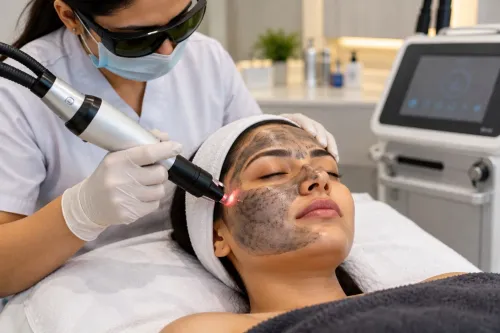
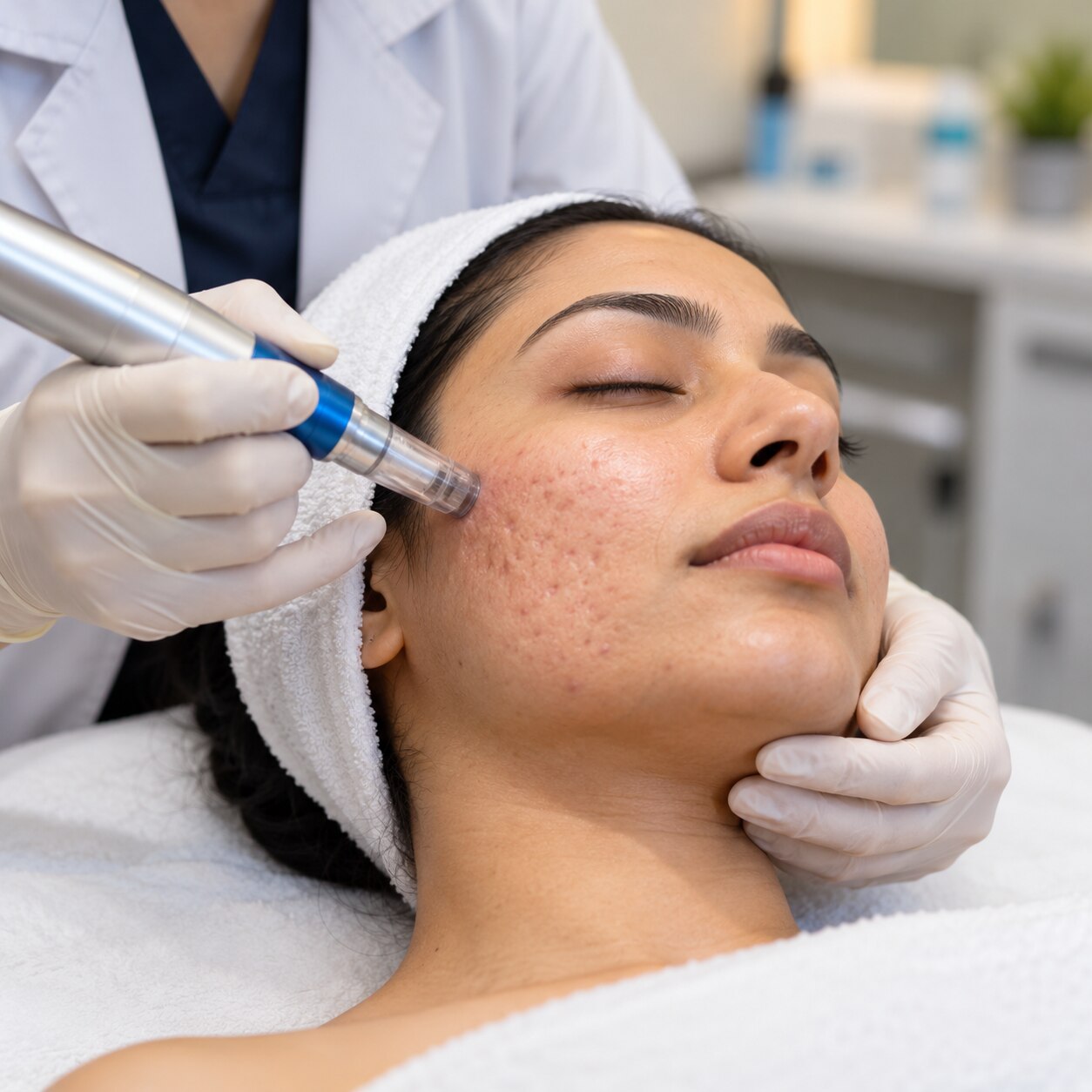
A professional session begins with cleansing and an assessment of your skin on that day. The clinician may apply a topical anaesthetic to intact skin for comfort, then remove it completely before treatment. Numbing cream should not cover broken or irritated skin unless specifically directed.
1. The clinician marks the treatment area and selects needle depth according to scar depth, skin response, and location. A new sterile cartridge is opened for your session and attached to the device.
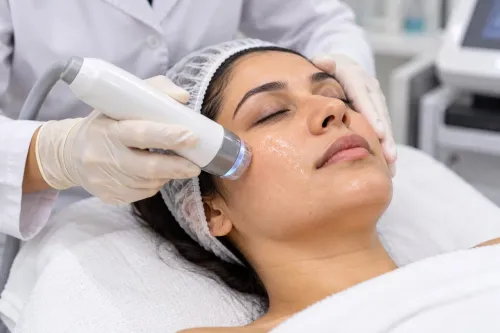
2. The device makes repeated, controlled passes across the skin. You may feel vibration, pressure, or brief pricks; pinpoint bleeding can occur, especially at greater depths. This is different from uncontrolled scraping or cutting.
3. After cleansing away blood and residue, the clinician applies a suitable finishing product and explains post-treatment care. Do not touch the area with unwashed hands, apply makeup, or use irritating active products until you receive clearance.
Redness, warmth, tightness, and mild swelling are expected during early recovery; these changes are not the final result. Use a gentle cleanser, moisturiser if advised, and broad-spectrum sunscreen while the barrier repairs. Avoid picking or vigorous rubbing. Sun exposure and excessive inflammation can increase dark or light marks, including in darker skin tones.
Collagen remodeling continues after the visible redness settles, so judge progress later rather than immediately.
How many sessions are needed and what improvement looks like
Plan on three to six sessions, with each session spaced four to six weeks apart. This interval lets treated skin recover before another controlled injury. Your dermatologist adjusts the session depth and total number according to scar appearance and your skin’s response to the device. These figures are a common framework, not a universal rule.
Do not judge the result by early redness, swelling, or roughness. Initial texture changes usually appear after several weeks, but meaningful assessment takes longer because the repair process continues after the surface settles. Collagen maturation can continue for several months after the last session.
Realistic acne-scar results mean softer edges and shallower depressions, not completely normal skin. Shallow depressed scars tend to show more change than deep, narrow scars, which often respond incompletely to microneedling alone. Residual depressions and uneven texture can remain.
If progress plateaus, repeating full-face sessions may not solve a deep scar; a focal procedure can be more appropriate. Judge the final result with follow-up photographs taken under the same lighting, not by day-to-day mirror checks.
How microneedling compares with other acne-scar procedures
Conventional microneedling is often the better starting point for rolling and shallow boxcar scars when you want collagen remodeling with less surface injury and downtime than aggressive resurfacing. It is less suitable for deep, tethered, narrow, or raised scars that need a targeted mechanical or chemical approach.
| Option | How it compares with conventional microneedling | When the alternative fits better |
|---|---|---|
| MNRF | Adds radiofrequency heat beneath the skin, creating stronger thermal remodeling with greater discomfort and risk of excessive inflammation. | Choose it for deeper scars or laxity when a clinician judges added heat appropriate. |
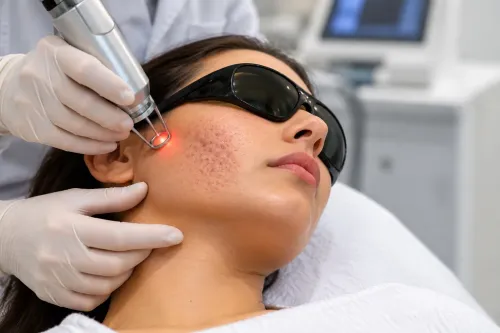
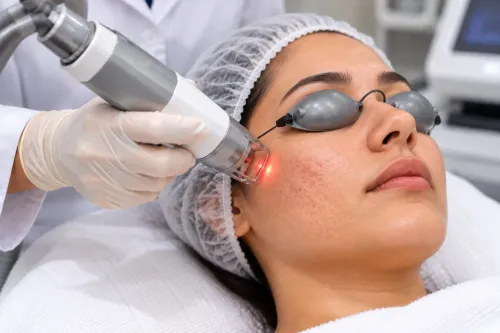
| Fractional laser resurfacing | Can produce greater texture change, but causes more prolonged redness, pigment alteration, and recovery, especially with aggressive settings. | Choose it for pronounced textural damage when downtime and pigment risk are acceptable. |
| Chemical peels | Treat surface discoloration and mild texture; they do not mechanically remodel deeper depressed scars in the same way. | Choose a peel for superficial marks or selected scar patterns. |
| Subcision | Releases fibrous bands that pull rolling scars downward; microneedling alone does not cut those tethers. | Choose subcision for clearly tethered rolling scars. |
| TCA CROSS | Delivers high-strength acid focally into ice-pick scars rather than treating the whole face. | Choose it when narrow, deep scars respond poorly to broad microneedling. |
| Dermabrasion | Removes more surface tissue and carries greater downtime and pigment risk. | Reserve it for selected severe, uneven surface scarring. |
| PRP | Supplies injectable growth factors but does not replace controlled dermal puncturing or scar release. | Use PRP alone only when injections suit the treatment plan; it is also used as an adjunct. |
A dermatologist may combine procedures, but active acne, infection, or a history of abnormal scarring changes the decision. Repeating microneedling on a poor target wastes recovery time.
Frequently asked questions
How does microneedling improve acne scars?
Fine needles create controlled punctures that activate wound healing and collagen remodeling in the dermis while preserving most of the epidermis.
Which acne scars are suitable for microneedling?
Microneedling is primarily used for depressed acne scars, but a dermatologist must assess the scar type and any active skin condition first.
What happens during a professional microneedling session?
The clinician evaluates your skin, prepares and cleans the treatment area, applies the device in a controlled pattern, and gives aftercare instructions.
How many microneedling sessions are needed for acne scars?
The number depends on scar depth, skin response, and treatment goals; improvement develops gradually and is assessed across sessions.
How does microneedling compare with other acne-scar procedures?
Microneedling stimulates collagen without removing the skin surface, while lasers, subcision, chemical peels, and fillers work through different mechanisms and suit different scar patterns.