Acne scars are not all the same: a rolling depression, a boxcar scar, a dark mark, and an enlarged pore need different decisions. By the end, you will know what fractional CO2 laser changes, which scars respond best, what recovery involves, and when another procedure may be a better starting point.
Key takeaways
- Fractional CO2 works best for atrophic rolling and boxcar scars.
- Deep ice-pick scars often need TCA CROSS or punch techniques.
- Darker skin requires conservative settings and careful pigment-risk planning.
- Expect redness, peeling, and strict sun protection during recovery.
How fractional CO2 laser remodels scarred skin
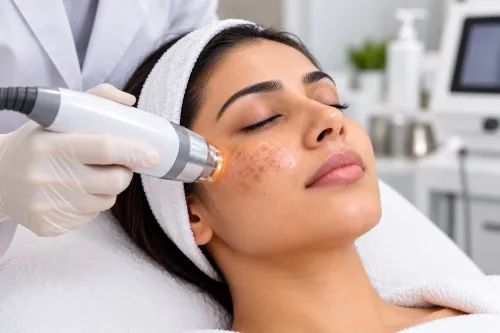
A fractional CO2 laser uses 10,600-nm laser energy to vaporize microscopic columns of water-rich skin. Because the injury is arranged in a grid, untreated skin remains between the fractional columns. Those intact areas supply cells that help the treated spots close and re-cover with new surface skin, making recovery shorter than full-field CO2 resurfacing.
1. The laser creates controlled thermal injury inside and around each microscopic column. This removes tiny portions of damaged tissue while heating nearby dermis, where acne-scar structure has become uneven.
2. During healing, the skin produces new collagen and reorganizes existing collagen fibres. This collagen remodeling gradually supports depressed scar floors, softens sharp edges, and smooths the transition between scars and surrounding skin.
3. The surface can look tighter and more even as the treated micro-injuries heal, but fractional CO2 does not physically erase every scar in one session. Improvement develops over weeks to months while dermal remodeling continues.
The treatment usually improves rolling scars and many shallow-to-moderate boxcar scars more readily than narrow ice-pick scars. Deep, sharply defined pits often need a focal treatment such as TCA CROSS or punch excision because resurfacing alone cannot reach their entire depth.
Fractional CO2 is ablative, not equivalent to a non-ablative fractional laser: it removes microscopic tissue rather than only heating it. A series of treatments is common, with session number and spacing determined by scar depth, treatment density, skin type, and the healing response.
Which acne scars are suitable—and which need a different technique
A depressed scar changes the skin’s contour: light creates a dip or shadow that remains when you stretch the skin. Fractional CO2 can improve rolling scars and shallow boxcar scars, but it will not stop active acne or remove a flat discolouration.
| Scar appearance | What it suggests | More suitable approach |
|---|---|---|
| Rolling scars | Broad, wavy depressions; some are tethered to deeper tissue | Fractional CO2 for surface texture; subcision if tethering keeps the dip fixed |
| Shallow boxcar scars | Wider depressions with defined, relatively shallow edges | Fractional CO2 can soften the edges and depth |
| Ice-pick scars | Narrow openings extending deeply into the skin | TCA CROSS treatment or punch excision, with or without later resurfacing |
| Flat brown marks | Post-inflammatory hyperpigmentation without a depression | Pigment control and sun protection, not scar resurfacing |
| Red or raised lesions | Active acne, inflamed marks, or hypertrophic scarring | Acne treatment or scar-specific care before considering laser |
Pressing or stretching the skin during examination helps reveal tethering and depth. A new tender bump, pus-filled lesion, crust, or recurring breakout means acne control comes first; otherwise, new scars can form during the treatment course.
Fractional CO2 is not automatically the best answer for every depression. Combining it with subcision, TCA CROSS, fillers, or punch techniques requires sequencing because extra inflammation can increase downtime and pigment risk. A dermatologist should also distinguish enlarged pores and redness from true scarring before choosing treatment.
What happens during treatment and how settings are chosen for darker skin
A fractional CO2 laser consultation begins with examination of scar depth, skin tone, active inflammation, previous pigment changes, and any history of cold sores. Photographs, treatment goals, expected downtime, and consent are reviewed before the skin is cleansed. A topical anesthetic is applied for the time recommended for that product, then removed before treatment.
Settings are selected for your skin, not copied from another patient. For Indian and other darker skin tones, the dermatologist may use lower energy, lower treatment density, fewer overlapping laser passes, or a test spot before treating a larger area.
Excess heat and overlapping columns increase inflammation and post-inflammatory hyperpigmentation, so stronger settings are not automatically better.
- Postpone resurfacing if you have active acne, dermatitis, an open wound, or a bacterial infection in the area.
- Tell the dermatologist about recurrent cold sores; antiviral prophylaxis may be prescribed because laser injury can reactivate herpes simplex.
- Ask how the plan limits heat, overlap, and unnecessary combination procedures, since added inflammation raises pigment risk.
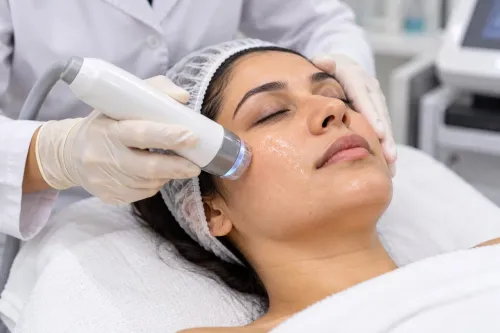
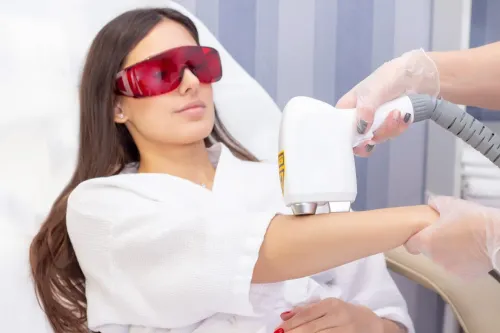
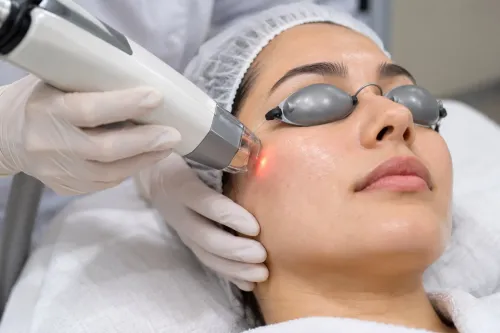
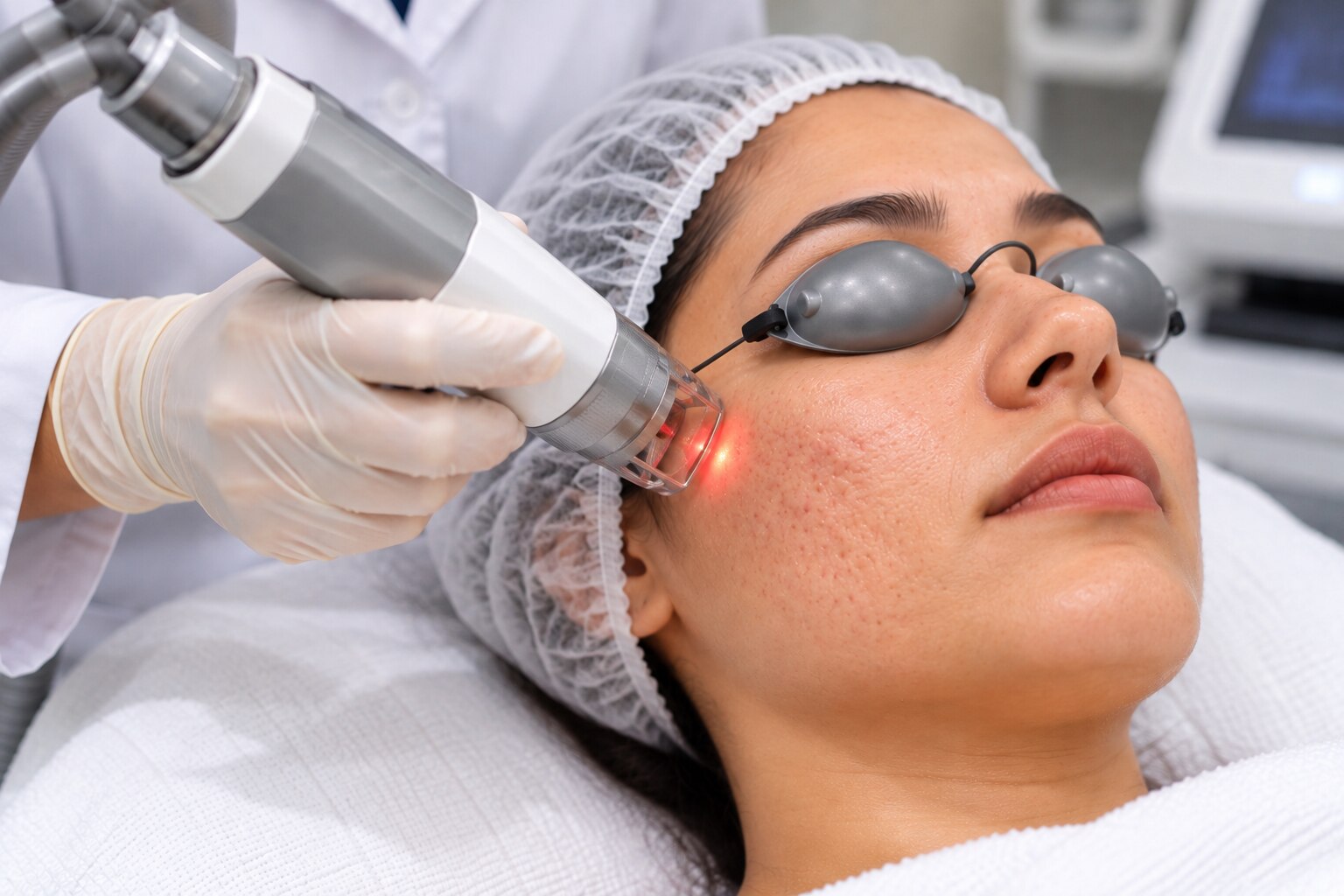
- Expect protective eyewear, controlled laser passes, and cooling after laser treatment. The treated skin can feel hot and tight, with redness or pinpoint oozing afterward.
Clean technique and precise aftercare reduce infection risk. Do not pick crusts, apply unapproved products, or expose freshly treated skin to heat, sweat, or contaminated water.
How many sessions you may need and what recovery looks like
Most people need two to four fractional CO2 laser sessions, not one. The treatment interval is commonly several weeks, allowing the surface to heal before another pass. Deeper scars, higher energy settings, dense treatment, darker skin, and combination procedures can lengthen the schedule.
Texture may look smoother after the first healing period, but collagen remodeling continues for about three to six months. Judge the final improvement after the full course, not when peeling stops. New acne must also be controlled, or fresh inflammation can create additional scars.
Early recovery commonly includes redness and swelling, heat or burning, tenderness, and pinpoint crusting. Oozing can occur during the first days, while redness may persist beyond the initial peeling period. Your return to work depends on treatment intensity and your job; desk work may be possible after several days, but visible redness can last longer.
During healing, follow the clinician’s dressing and cleansing instructions and do not pick crusts. Your checklist is:
- Use broad-spectrum sun protection and avoid direct sun; pigment changes are more likely after ultraviolet exposure.
- Avoid makeup, retinoids, exfoliating acids, scrubs, and unapproved creams until the surface has closed.
- Delay strenuous exercise, swimming, saunas, and dusty or hot environments while oozing, crusting, or marked redness remains.
- Contact the treating clinician for worsening pain, pus, fever, spreading redness, or blisters.
How fractional CO2 compares with other acne-scar treatments
Ablative fractional CO2 is the better choice when rolling scars or shallow-to-moderate boxcar scars need stronger surface resurfacing and collagen remodeling than a gentler procedure can provide. The trade-off is more redness, crusting, healing time, and pigment risk, especially in darker skin.
- Non-ablative fractional laser: Choose it when you want less downtime and a lower surface-injury burden, accepting that texture improvement may be slower or less pronounced.
- MNRF for acne scars: Consider it when you need dermal collagen stimulation with limited epidermal disruption, particularly if pigment risk or recovery time makes CO2 unsuitable.
- Microneedling for texture: It suits mild textural irregularity and patients seeking a simpler recovery, but it may not adequately improve deeper boxcar scars.
- Scar-specific combination plan: Choose this when one scar type needs a targeted procedure. Subcision releases tethered rolling scars; TCA CROSS or punch techniques address narrow ice-pick scars. Fractional CO2 can follow for broader texture, but combining procedures increases inflammation, downtime, and pigment risk.
A dermatologist-led scar treatment should match each scar rather than defaulting to the strongest laser. Dr. Swati Gurav Dermatologist & Cosmetologist can assess whether active acne, pigmentation, tethering, or scar depth changes the treatment order before resurfacing.
Related services
Laser Facial Revitalize your skin with an advanced Laser Facial at Dr. Gurav’s Skin Hair Laser Clinic, Dombivli. Performed by Dr. View service → |
Acne , Scar and Pigmentation Management Acne , Scar and Pigmentation Management Dr. Swati Gurav is a leading skin and cosmetology specialist in Dombivli, offering expert care for acne, acne scars, and pigmentation concerns. View service → |
Frequently asked questions
How does fractional CO2 laser remodel acne scars?
The 10,600-nm laser creates microscopic columns of controlled injury, stimulating collagen remodeling while untreated skin supports faster healing.
Which acne scars are suitable for fractional CO2 laser?
Rolling and shallow-to-moderate boxcar scars often respond well. Deep ice-pick scars usually need TCA CROSS or punch excision first.
How are fractional CO2 settings chosen for darker skin?
A dermatologist adjusts energy, density, and treatment passes to balance scar improvement against post-inflammatory hyperpigmentation risk.
What is recovery like after fractional CO2 laser?
Expect redness, swelling, pinpoint crusting, peeling, and increased sun sensitivity. Follow wound-care instructions and use strict sun protection.
How does fractional CO2 compare with other acne-scar treatments?
Fractional CO2 targets texture broadly, while microneedling, radiofrequency, subcision, TCA CROSS, fillers, and punch procedures suit different scar types.